In this section: Culture
Pysanky
How a pysanka, a Ukrainian egg “written” with wax and dyes, is made, what people do with pysanky, how the styles differ from region to region, and why there is no fixed key to what the patterns mean.
On this page
A pysanka (пи́санка, plural pysanky) is an egg decorated with wax and dyes. Many Ukrainian families make them in the days before Easter, and give them as gifts. In December 2024 UNESCO added Pysanka, Ukrainian tradition and art of decorating eggs to its Representative List of the Intangible Cultural Heritage of Humanity.
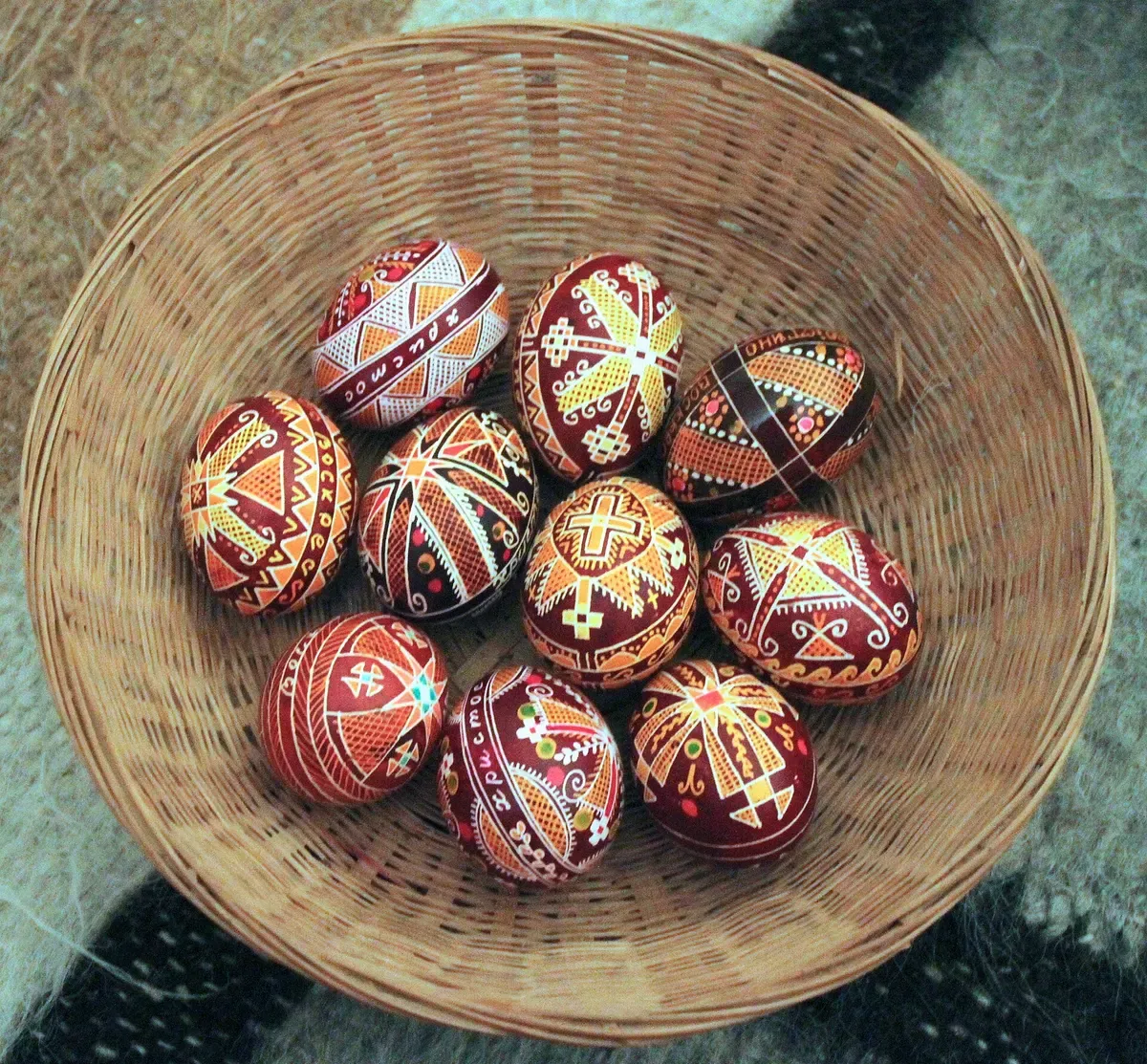

A “written” egg
Makers usually say they write a pysanka, not that they paint it. The word comes from писа́ти, “to write”. Dictionaries of word origins add that, long ago, the same root meant “to decorate, to make colourful”, and that older sense lives on in пи́санка.
How a pysanka is made
Pysanky are made on raw eggs with a wax-resist method, a little like batik on cloth. Wherever there is wax, the dye can’t reach. The tool is a kystka (often spelled kistka in English): a small metal cone, like a tiny funnel, on a wooden handle. It holds hot wax, and the maker draws with it as with a pen.
- On the clean white egg, draw in wax every line that should stay white.
- Dip the egg in yellow dye.
- Cover with wax everything that should stay yellow.
- Dip in red, then wax the parts that should stay red.
- Dip in a dark colour, usually dark violet or black.
- Melt the wax off. Only now do all the colours appear.
Some makers use more colours, but the idea is always the same: wax, dye, and repeat, from the lightest colour to the darkest. Dyes were traditionally made from plants, for example onion skins. Today synthetic dyes are widely used.
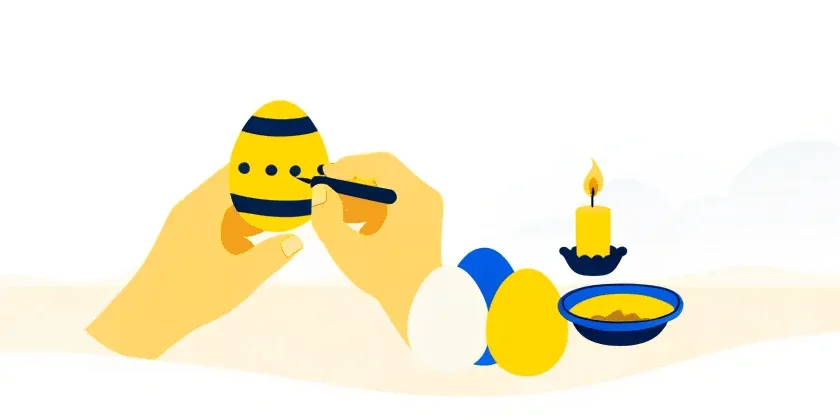
Krashanky and other eggs
A pysanka is one of several kinds of decorated egg. A krashanka (кра́шанка) is boiled and dyed one solid colour. On a kapanka, hot wax is dripped onto the egg before dyeing. On a driapanka, the design is scratched into an egg that has already been dyed. A malovanka is painted with a brush. There are also pysanky made of wood, stone or clay.
Easter, spring and the home
Pysanky are usually decorated just before Easter. UNESCO’s description says the tradition goes back to pre-Christian times and became an Easter tradition over time. Pysanky are widely associated with spring and, for Christians, with the Resurrection.
UNESCO’s description, based on Ukraine’s nomination, gives a picture of what people do with them:
- They are given as gifts, and they matter to many Ukrainians whatever their religion.
- After Easter, blessed pysanky are kept at home “as a source of protection”.
- They are also made for births, christenings and weddings, and in memory of the dead.
- The skill is passed on in families, and also in classes and workshops.
The Encyclopedia of Ukraine notes that “in earlier times people believed in the magical powers of the pysanka”. That is a folk belief, and it is described here as one.
Styles from region to region
Pysanky from different parts of Ukraine look different. The Encyclopedia of Ukraine describes some of the regional styles:
- In central Ukraine, around Kyiv and Poltava, stylised plants, geometric shapes and the meander, called the “endless line” (bezkonechnyk).
- In the Chernihiv region, more naturalistic, asymmetrical flowers.
- In western Ukraine, mostly geometric designs, with exceptions such as the rich floral eggs from around Sokal.
- In the Hutsul region, intricate geometric designs. The Hutsul pysanka tradition has its own entry in Ukraine’s national register of intangible heritage.
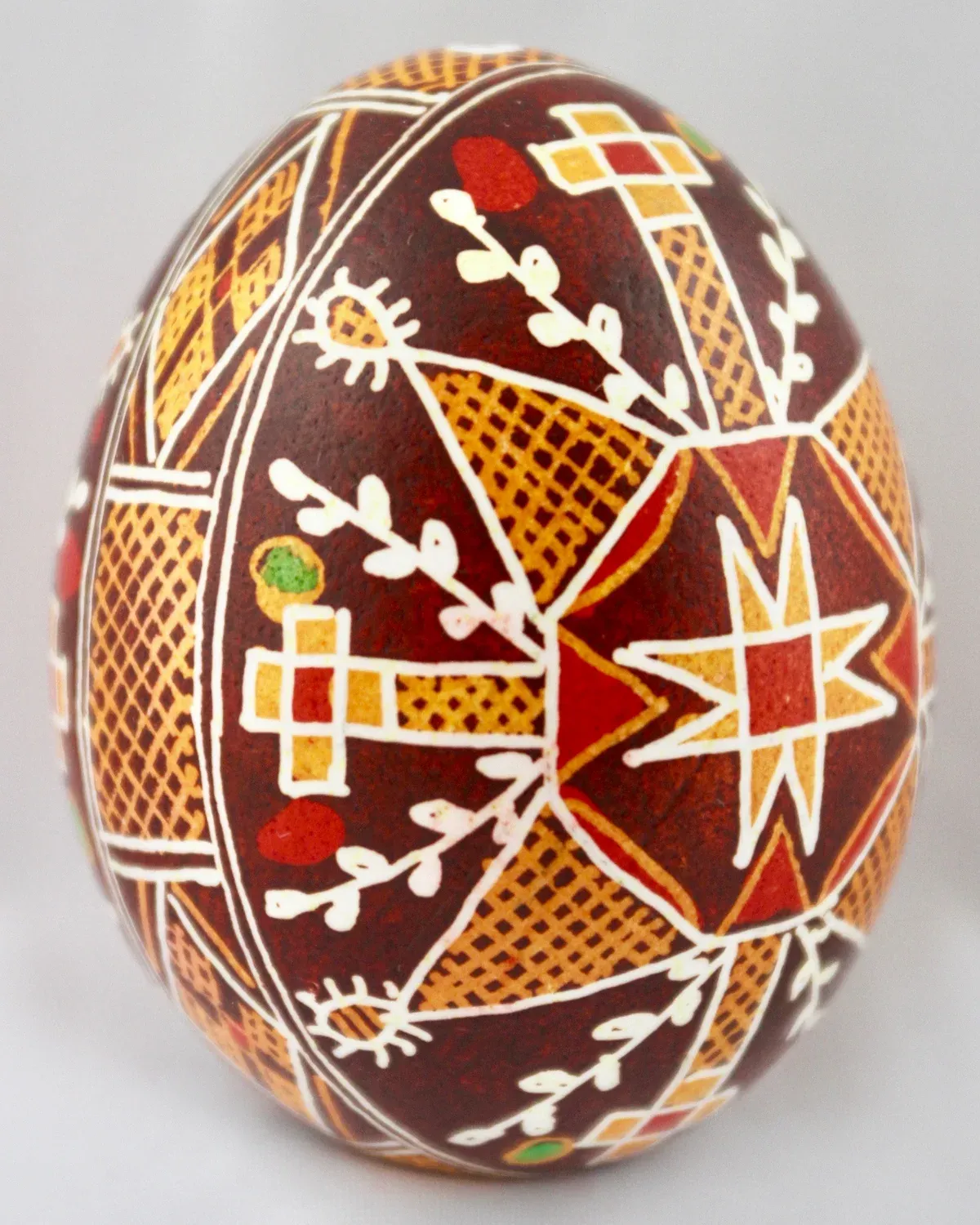

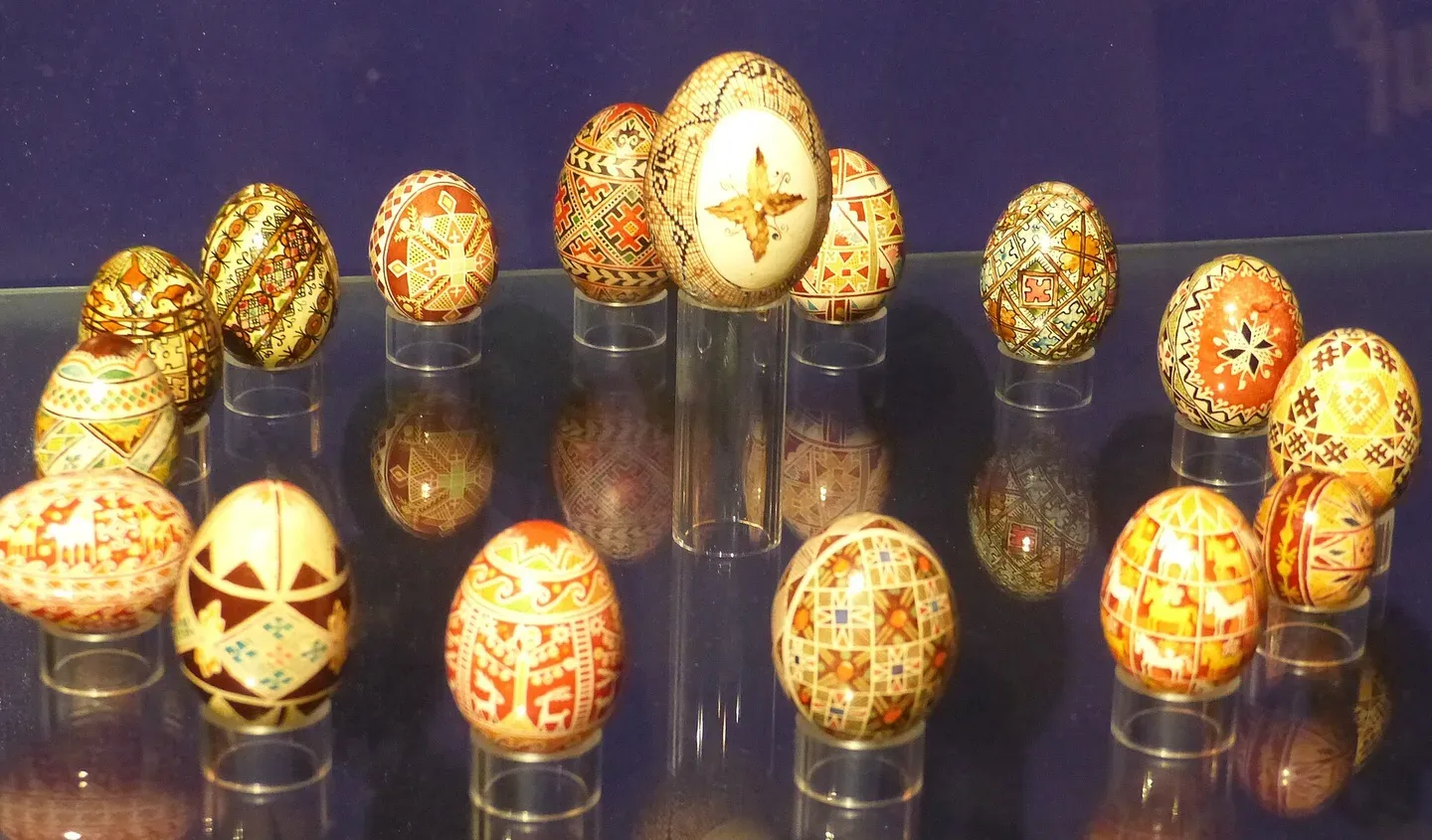
The photo above shows a design from Pokuttia, another region in the west. Styles like these are broad lines, not rules.
What do the patterns mean?
Pysanky are covered in motifs with names: stars, crosses, triangles, plants, the endless line. You will find books and websites that give each colour and shape a fixed meaning. Be careful with them. The pysanka researcher Luba Petrusha points out that the names and meanings of motifs vary from region to region, and even from village to village, and that little in the early writing on pysanky supports many of the meanings given in popular books. The University of Kansas’s guide to pysanky says the same: the symbolism changes by region and over time. There is no single key.
UNESCO puts it in a way that leaves room for the maker: “Personal wishes and messages are captured in the symbols used.” That is why this page names the motifs but doesn’t translate them.
UNESCO, Estonia and museums
UNESCO inscribed pysanka on its Representative List in December 2024, at the meeting of its intangible heritage committee in Asunción, Paraguay. The nomination came jointly from Ukraine and Estonia. The reason is that Ukrainians living in Estonia keep the tradition there. Ukraine’s Ministry of Culture says the work on the joint nomination began in 2017, after a meeting with Ukrainian tradition bearers in Estonia, and that the file brings together pysanka entries from both countries’ national registers, including the Hutsul tradition.
Museums collect pysanky too, in Ukraine and abroad. The Ukrainian Museum in New York, founded in 1976, describes its collection of pysanky as “outstanding”. Museums elsewhere show them too, such as the city museum of Schwabach in Germany.

Pysanky in your Ukrainian
Яйце́ is in the food and drink vocabulary, and писа́ти is among the common verbs. To describe a pysanka, put the colour word in the right gender: черво́на пи́санка, черво́не яйце́. Adjectives and agreement shows how. And when you say what you write with, Ukrainian uses the instrumental case: писа́ти во́ском, “to write with wax”, as in Tools and transport.

A little Ukrainian
Words for describing a pysanka. Colour words agree with the noun: жо́вта пи́санка (feminine), but жо́вте яйце́ (neuter).
- пи́санка
- pysanka, a decorated eggfeminine; from писа́ти
- писа́ти
- to writeя пишу́, ти пи́шеш, вона́ пи́ше
- яйце́
- eggneuter; plural я́йця
- віск
- waxmasculine; genitive во́ску
- фа́рба
- dye, paintfeminine
- візеру́нок
- pattern, designmasculine
Words without a native-speaker recording are read by a computer-generated voice (OpenAI text-to-speech); the written form, with its stress marks, is the reference.
Read about it in Ukrainian
A short text on this topic, with a word list, a translation, audio and questions.
Related learning
Picture credits
- Eleven eggs in a wicker basket, decorated in dark red, orange, yellow and white with crosses, stars, triangles and fine net patterns; some have Cyrillic lettering around the middle: Photo: Luba Petrusha (Lubap), Wikimedia Commons, CC BY-SA 4.0, file page.
- Illustration of two hands drawing dark stripes and dots on a yellow egg, beside a candle, a small bowl and three plain eggs: made for Blabober with Recraft.
- A single egg on a light grey background, dark maroon with white lines dividing it into sections filled with yellow and orange cross-hatching, an eight-pointed star, cross shapes and small white sprigs: Photo: Luba Petrusha, Wikimedia Commons, CC BY-SA 4.0, file page.
- About twenty decorated eggs on small clear stands in a museum case, patterned with stars, rosettes, a tree and rows of small animals in red, orange, yellow, black and cream, against a dark blue background: Photo: Wolfgang Sauber, Wikimedia Commons, CC BY-SA 4.0, file page.
Sources
- Pysanka, Ukrainian tradition and art of decorating eggs (element page, No. 02134) (UNESCO Intangible Cultural Heritage)
- Decision 19.COM 7.B.14 (UNESCO Intangible Cultural Heritage)
- The Ukrainian tradition and art of egg decoration recognized as the cultural heritage of humanity (Ministry of Culture and Strategic Communications of Ukraine)
- Easter egg (Volodymyr Hodys, Internet Encyclopedia of Ukraine (Canadian Institute of Ukrainian Studies), from the Encyclopedia of Ukraine, vol. 1 (1984))
- Pysanky (University of Kansas, Center for Russian, East European & Eurasian Studies)
- Pysanky, Ukraine's centuries-old Easter egg tradition (Mia Billetdeaux, The Kyiv Independent)
- Pysanka symbols (Luba Petrusha, pysanky.info)
- The collection (The Ukrainian Museum, New York)
- Горох, a Ukrainian dictionary with stress (word forms and etymology) (goroh.pp.ua)
Last updated