
In this section: Culture
Borshch and the Ukrainian table
What borshch is, what goes into it, how it changes from region to region and season to season, and what UNESCO's 2022 listing of Ukrainian borshch cooking does and does not mean.
On this page
Borshch (борщ) is a soup, usually deep red from beetroot, that UNESCO calls “an integral part of Ukrainian family and community life”. In English it is often spelled borscht. There is no single recipe: it changes from region to region, from season to season and from one family’s kitchen to the next. In 2022 UNESCO added the culture of Ukrainian borshch cooking to its list of heritage in need of urgent safeguarding.
What goes into borshch
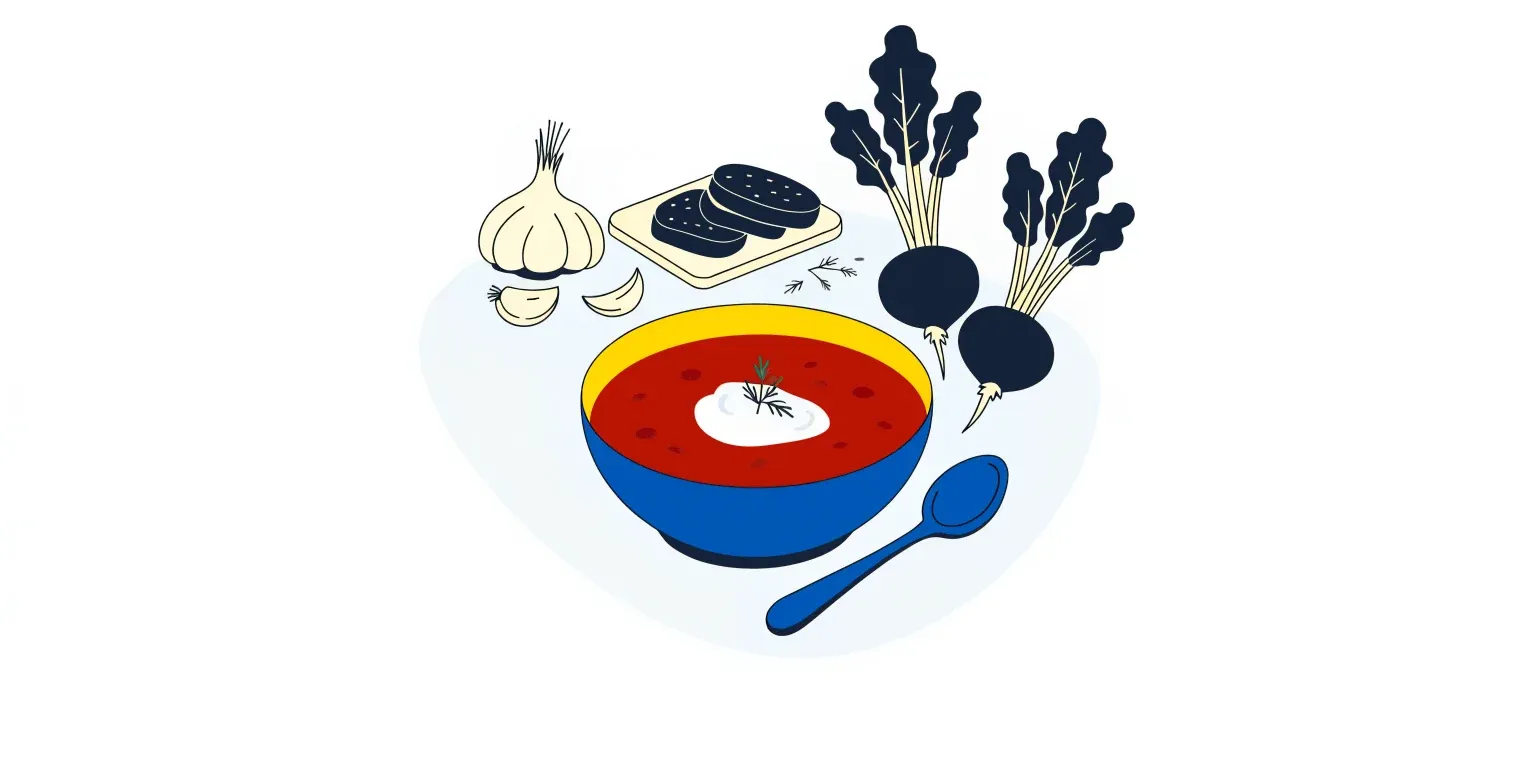
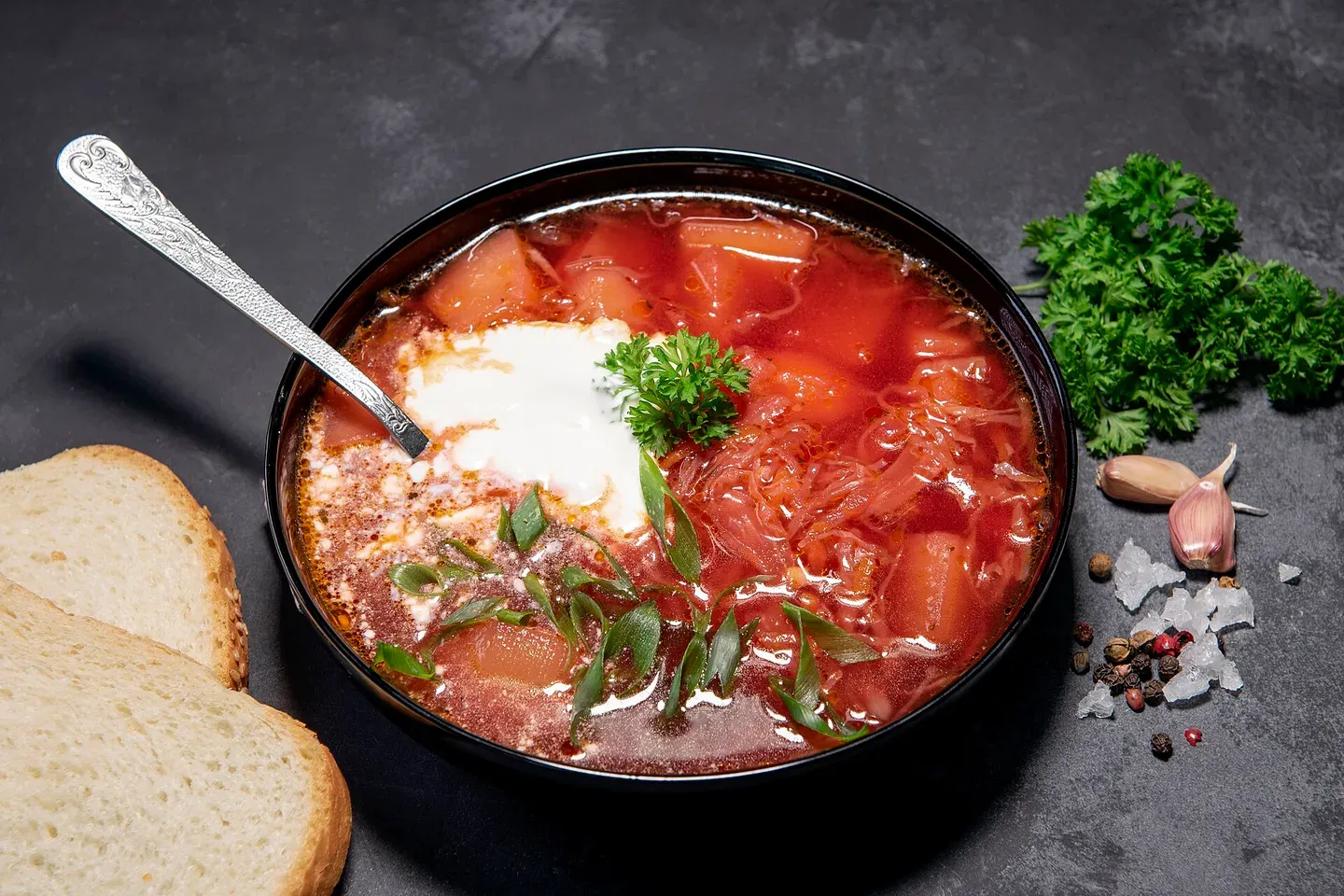
UNESCO describes borshch as cooked with broth combined with beetroot, sugar beet or fermented beet juice, in a large pan or pot. Beetroot and cabbage are the main vegetables, and the stock is made with meat or fish, or with neither. There are many versions: UNESCO’s announcement of the listing mentions variations with mushrooms, fish or sweet peppers.
Borshch usually comes to the table with a spoonful of sour cream (смета́на) and something to eat with it: rye bread, or pampushky, small yeast rolls topped with garlic. Older descriptions also mention small filled pies, pyrizhky.

Where the name comes from
The word борщ first meant a plant, hogweed. Hogweed was once cooked into a sour soup, and over time other vegetables took its place, above all beetroot. The name stayed with the soup.
Blabober writes borshch because Ukraine’s official romanisation writes the letter щ as shch. Borscht is the usual English dictionary spelling, and it is the one UNESCO uses. You will also see borsch. For how Ukrainian names are spelled in English, see Stress and transliteration.
Borshch at the table
Traditionally, a soup or borshch was expected with the main meal of the day, and borshch has long been the favourite soup. It is an everyday dish, but it also belongs to special days. The Encyclopedia of Ukraine lists borshch among the dishes served on Christmas Day, New Year’s Day and Epiphany. In many Christian families the Christmas Eve supper is meatless, and for it there is a meatless borshch, cooked in water and soured with beet kvas, a fermented beet liquid.
Borshch also turns up in family rituals. In the Podillia region, the third day of a wedding has been called do nevistky na borshch, “to the daughter-in-law, for borshch” (до неві́стки на борщ).
The description in Ukraine’s UNESCO nomination puts the social side first. It calls borshch an expression of hospitality that brings people of all ages, genders and backgrounds to the same table. Women do most of the cooking, it says, but many men cook it as an everyday dish too. Recipes are passed down in families, with children helping in the kitchen, and borshch is praised in folk tales, songs and proverbs.
Note
Many kinds of borshch
UNESCO notes that borshch reflects the local products of each region. The Encyclopedia of Ukraine names regional styles, such as Poltava, Kyiv and Galician borshch, and seasonal ones:
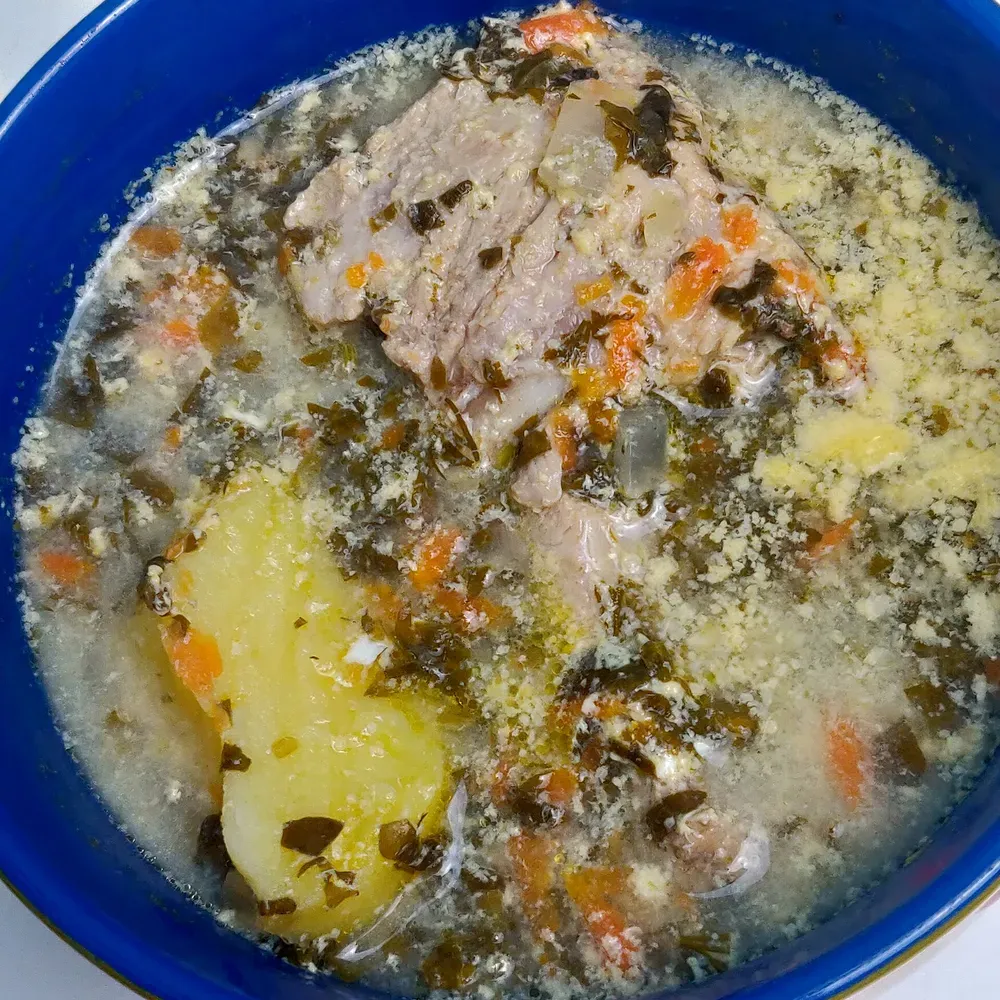
- Green borshch is built on sorrel (щаве́ль), a leafy plant with a sour taste. It is a spring dish, often served with hard-boiled egg and sour cream.
- Cold borshch, also called kholodnyk, is a summer soup of young beets, kvas, sour cream, herbs and eggs.
- Clear borshch is served as a clear broth.
- Meatless borshch, like the Christmas Eve one, is cooked without meat stock.

Borshch isn’t only Ukrainian. UNESCO calls Ukrainian borshch “the national version of borscht consumed in several countries of the region”. Ashkenazi Jewish cooks have their own borshch, often made without meat and eaten at Passover and Shavuot, and there are versions in Moldova, Romania, Georgia and elsewhere. In recent years borshch has also become a contested symbol in a wider dispute over cultural heritage between Ukraine and Russia; media reports trace that dispute to a 2019 tweet by the Russian Foreign Ministry.
The UNESCO listing
On 1 July 2022, UNESCO inscribed the Culture of Ukrainian borscht cooking on its List of Intangible Cultural Heritage in Need of Urgent Safeguarding. Ukraine had already entered borshch cooking on its national list of intangible heritage in 2020. Because of the war, Ukraine asked UNESCO to examine the nomination on a fast track, and the committee inscribed it “as a case of extreme urgency”. UNESCO’s reasoning was that the war threatened the practice itself: many people had been forced from their homes, and some could no longer cook borshch, grow the vegetables for it, or gather to share it.
What UNESCO lists is the culture of cooking borshch, the practice as people live it, rather than a recipe or the dish as such. UNESCO’s decision notes that the culture of borshch cooking is shared with other communities in the region, and that inscription “does not imply exclusivity or ownership”.
You can read the element page on UNESCO’s site.
Borshch in your Ukrainian
You may have met борщ already: it is in the food and drink vocabulary, and in the reading text Calling Mum, where Andriy asks for borshch and varenyky. When you offer or ask for some borshch, Ukrainian uses the genitive, борщу́, the way it does for other foods and drinks: see The genitive. To offer food politely, choose the form for ви or ти, as the politeness lesson explains.

A little Ukrainian
Words for the table. After Хо́чете…? (Would you like…?) a food takes the genitive: борщу́, “some borshch”.
- борщ
- borshchmasculine; genitive борщу́
- буря́к
- beetrootmasculine
- капу́ста
- cabbagefeminine
- смета́на
- sour creamfeminine
- Смачно́го!
- Enjoy your meal!said to someone who is about to eat or is eating
- Пригоща́йтеся!
- Help yourself! Help yourselves!to one person formally, or to several people; to a friend or a child, Пригоща́йся!
Words without a native-speaker recording are read by a computer-generated voice (OpenAI text-to-speech); the written form, with its stress marks, is the reference.
Read about it in Ukrainian
A short text on this topic, with a word list, a translation, audio and questions.
Related learning
Picture credits
- Illustration of a bowl of red borshch with sour cream and dill, with beetroots, rye bread and garlic: made for Blabober with Recraft.
- A black bowl of deep red soup with chunks of potato and shredded cabbage, topped with a spoonful of white sour cream, parsley and chopped green onion, with slices of white bread, garlic cloves and peppercorns beside it on a dark stone surface: Photo: Evil linnka, Wikimedia Commons, CC BY-SA 4.0, file page.
- Seen from above, a blue bowl of pale soup with dark green leaves, orange carrot pieces, a chunk of potato, pieces of pork and crumbled yellow egg yolk: Photo: Amakuha, Wikimedia Commons, CC BY-SA 4.0, file page.
Sources
- Culture of Ukrainian borscht cooking (element page, file No. 01852) (UNESCO Intangible Cultural Heritage)
- Decision 5.EXT.COM 5 (UNESCO Intangible Cultural Heritage)
- Culture of Ukrainian borscht cooking inscribed on the List of Intangible Cultural Heritage in Need of Urgent Safeguarding (UNESCO Intangible Cultural Heritage)
- Culture of Ukrainian borscht cooking inscribed on the List of Intangible Cultural Heritage in Need of Urgent Safeguarding (UNESCO)
- Traditional foods (S. Stechishin, Internet Encyclopedia of Ukraine (Canadian Institute of Ukrainian Studies))
- Borsch: a Ukrainian staple (Mia Billetdeaux, The Kyiv Independent)
- A brief history of borshch (Daniel Zhang, Smithsonian Center for Folklife and Cultural Heritage)
- Not All Quiet on the Culinary Front: The Battle Over Borshch in Ukraine (Mariya Lesiv, Folklorica, vol. 25)
- Report on the current status of United Nations romanization systems for geographical names, version 3.0 (Ukrainian) (UNGEGN Working Group on Romanization Systems)
- Горох, a Ukrainian dictionary with stress (word forms and etymology) (goroh.pp.ua)
Last updated