
In this section: Culture
Lviv: a city profile
Why Lviv matters. A city of many rulers and many communities, with a historic centre on the UNESCO World Heritage List, churches of several traditions, and a long history of books and learning.
On this page
Lviv (Львів) is the largest city in western Ukraine. For seven centuries it has been ruled by different states and shared by different peoples, and its old centre still shows it: a market square with a town hall in the middle, narrow streets, and churches of several Christian traditions. Since 1998 the historic centre has been on UNESCO’s World Heritage List. Lviv also has a long history as a city of universities, books and theatre.
Where Lviv is
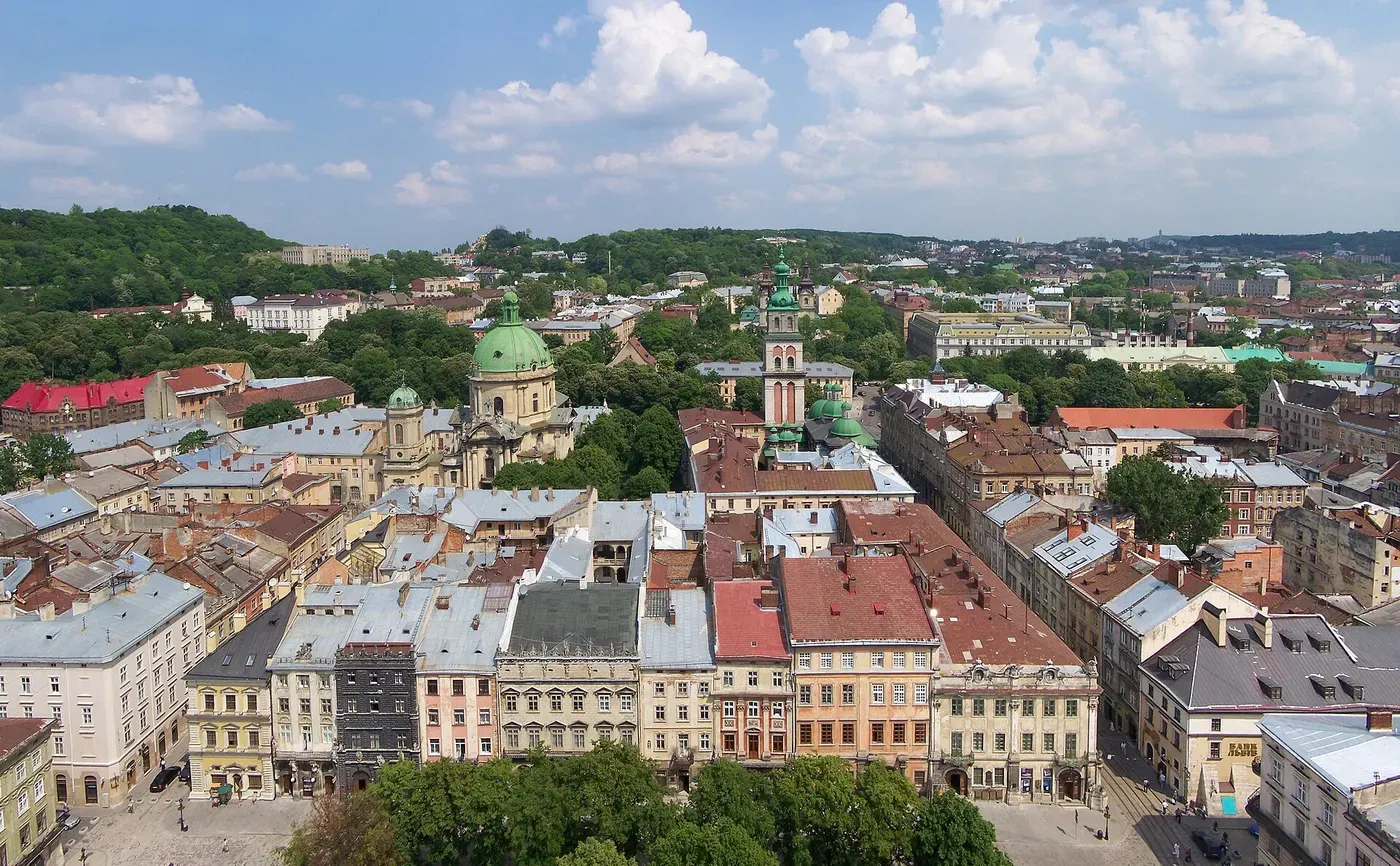
Lviv is the centre of Lviv oblast and the historic capital of Galicia, a region in the west of Ukraine. The oldest part of the city lies in a river valley below a hill called the High Castle (Висо́кий За́мок, Vysokyi Zamok, 413 m). The river, the Poltva, still runs under the centre, but it has been covered over since 1841.
The site mattered for trade. Routes from the Baltic to the Black Sea and from Kraków to Kyiv crossed here, and they were the main reason the city grew.
Because so many peoples have lived in Lviv, it has several names. In Polish it is Lwów, in German Lemberg, in Latin Leopolis and in Russian Lvov. In English, this site uses Lviv, the official transliteration of the Ukrainian name.

A city of many rulers
People lived on the site long before the city was founded. Lviv itself dates from the mid-13th century. Prince Danylo Romanovych founded it and named it after his son Lev, so the name means “Lev’s city”; лев is also the Ukrainian word for a lion. Here are the main periods, in brief:
- Mid-13th century: founded by Prince Danylo; first mentioned in a chronicle under the year 1256.
- From the 1260s: capital of the principality of Galicia-Volhynia.
- 1349 to 1772: taken by King Casimir III of Poland, then, after a short period of joint Polish-Hungarian rule, part of the Kingdom of Poland. In 1356 the city received Magdeburg law, a German form of town self-government. It applied only to Catholics, so Orthodox Ukrainians had no part in running the city.
- 1772 to 1918: under Austria, as the capital of the province of Galicia. The old city walls came down from 1777 and were replaced by tree-lined boulevards.
- 1918 to 1939: Ukrainians and Poles fought over the city in 1918–19. Between the wars it belonged to Poland.
- 1939 to 1944: Soviet occupation from September 1939, then German occupation from June 1941 to July 1944.
- 1944 to 1991: part of Soviet Ukraine.
- Since 1991: part of independent Ukraine.
A city of many communities
For centuries Lviv was home to Ukrainians, Poles, Jews, Armenians and others. UNESCO’s reasons for listing the old centre say this directly: trade and government drew people of different cultures and faiths, who built separate communities that depended on one another, and the buildings they left are still part of the townscape. In UNESCO’s words, the surviving buildings include “a mosque, a synagogue and a variety of religious buildings from the Orthodox, Armenian and Catholic churches”.
The Second World War and the years after it changed the city’s population radically. More than 200,000 Jews were in the city in September 1939, nearly half of them refugees from German-occupied Poland. In July 1941, in the first weeks of the German occupation, thousands of the city’s Jews were killed in pogroms. The US Holocaust Memorial Museum names the perpetrators as Ukrainian nationalists and militia, encouraged by the German forces, together with German forces and some local residents. Later in 1941 the Germans forced the city’s Jews into a ghetto. Tens of thousands were deported to the Belzec killing centre, others were sent to the Janowska camp, and thousands were killed in the city itself. By the end of the war most Jews in the region had been murdered.
After the war, under a Soviet–Polish population exchange, almost all of the city’s Poles were sent to Poland, and Ukrainians, including people forcibly resettled from areas that became part of Poland, became by far the largest group.
These layers mean that Lviv, Lwów or Lemberg matters to the memory of several peoples, not just one.
The UNESCO historic centre
The World Heritage property is called “L’viv – the Ensemble of the Historic Centre”. It was inscribed in 1998, and it has two parts:
- the castle hill and the area around it, known as Підза́мче (Pidzamche, “below the castle”), together with the city centre, середмі́стя (seredmistia);
- a smaller area on St George’s Hill, around St George’s Cathedral.
In plain English, UNESCO lists it for two reasons. The streets and buildings mix the building traditions of Eastern Europe with those of Italy and Germany. And the many communities that came to the city left a townscape where their different traditions can still be seen side by side.
A great fire in 1527 destroyed most of the Gothic town, and another followed in 1571, but the medieval street pattern and the narrow building plots survived. The old town came through the Second World War largely intact, though with some losses. In September 2023 UNESCO added it to the List of World Heritage in Danger, because of the threat from the Russian offensive.
Rynok Square and the old town
At the heart of the old town is Rynok Square (пло́ща Ри́нок, “Market Square”). It is a rectangle with the town hall, the ра́туша, standing in the middle. The present town hall and the four fountains around it were built in 1827–35.
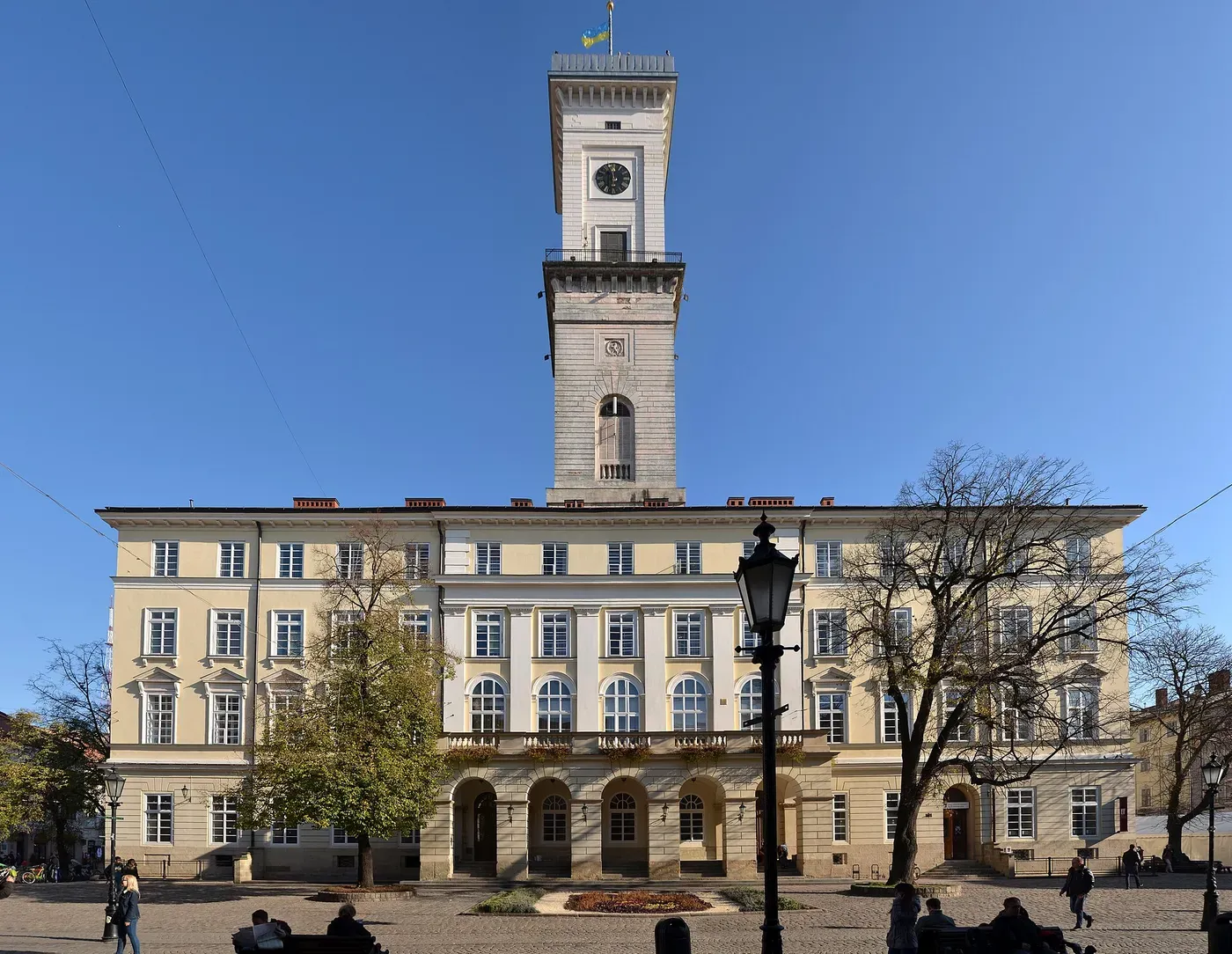

Around the square stand rows of old houses. Some date from the Renaissance, after the fire of 1527, such as the Black House (1577–88) and the Korniakt House (1580). Of the towers that once guarded the city walls, only one survives, the Gunpowder Tower.
Churches of many traditions
The old town has churches of different Christian traditions, among them:
- the Latin Cathedral, Roman Catholic, begun in the 14th century and rebuilt in 1761–76;
- the Armenian Cathedral;
- the Dormition Church (1591–1629), with the Korniakt tower beside it.
The Golden Rose Synagogue (1582) was built in the same period. The Nazis plundered it in 1941 and blew it up in 1943, and since 2016 its remains have been part of a memorial on the site.
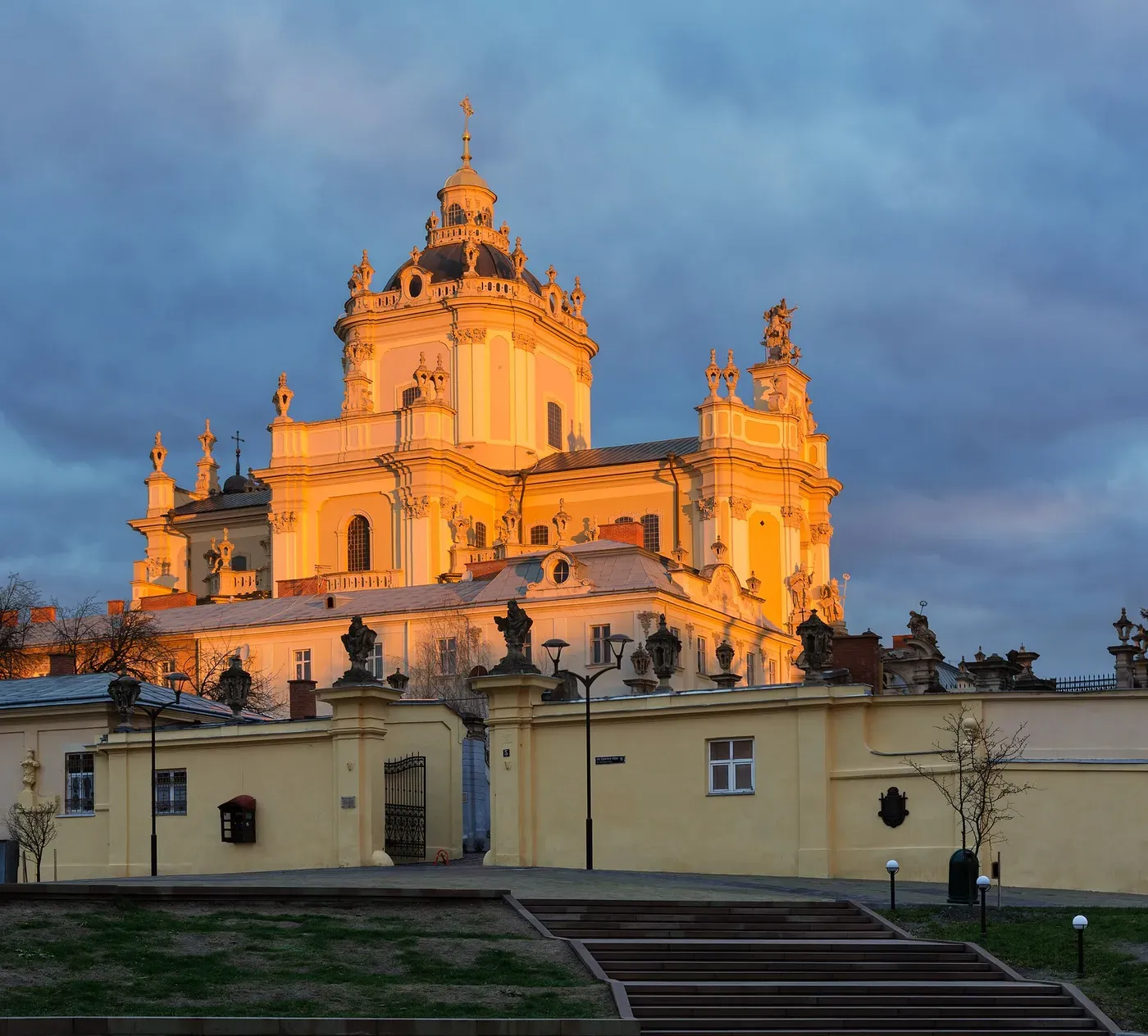
South-west of the old centre, on its own hill, stands St George’s Cathedral (UNESCO calls it St Yuri’s, after its Ukrainian name). It is a rococo church, built in 1744–59 and finished in 1764. From 1817 to 1946 it was the seat of the metropolitans, the leading bishops, of the Ukrainian Greek Catholic Church. The Soviet authorities abolished that church in 1946. It was recognised again in 1990, and the cathedral was returned to it.

According to Lviv’s profile in UNESCO’s Creative Cities Network, in the early 20th century Lviv was the seat of three Catholic archbishops at once: Latin, Greek Catholic and Armenian Catholic.
Books, learning and the stage
Lviv’s university traces its origins to 1661, when the king of Poland gave the city’s Jesuit college the rank of a university. The modern university was founded under Austrian rule in 1784; today it is the Ivan Franko National University of Lviv. Lviv Polytechnic and the Ukrainian Catholic University are among the city’s other universities.
In the late 19th and early 20th centuries Lviv was a centre of Ukrainian learning and publishing, home to the Shevchenko Scientific Society, founded in 1873. According to the Encyclopedia of Ukraine, in 1913 65 of the world’s 83 Ukrainian periodicals were published in Lviv. At the same time the city was a Polish political and cultural centre.
The city still describes itself as a city of writers, publishers and readers. Since 2015 it has been a UNESCO City of Literature, and according to its profile in UNESCO’s network, the Lviv International Festival of Literature has been held since 1997.
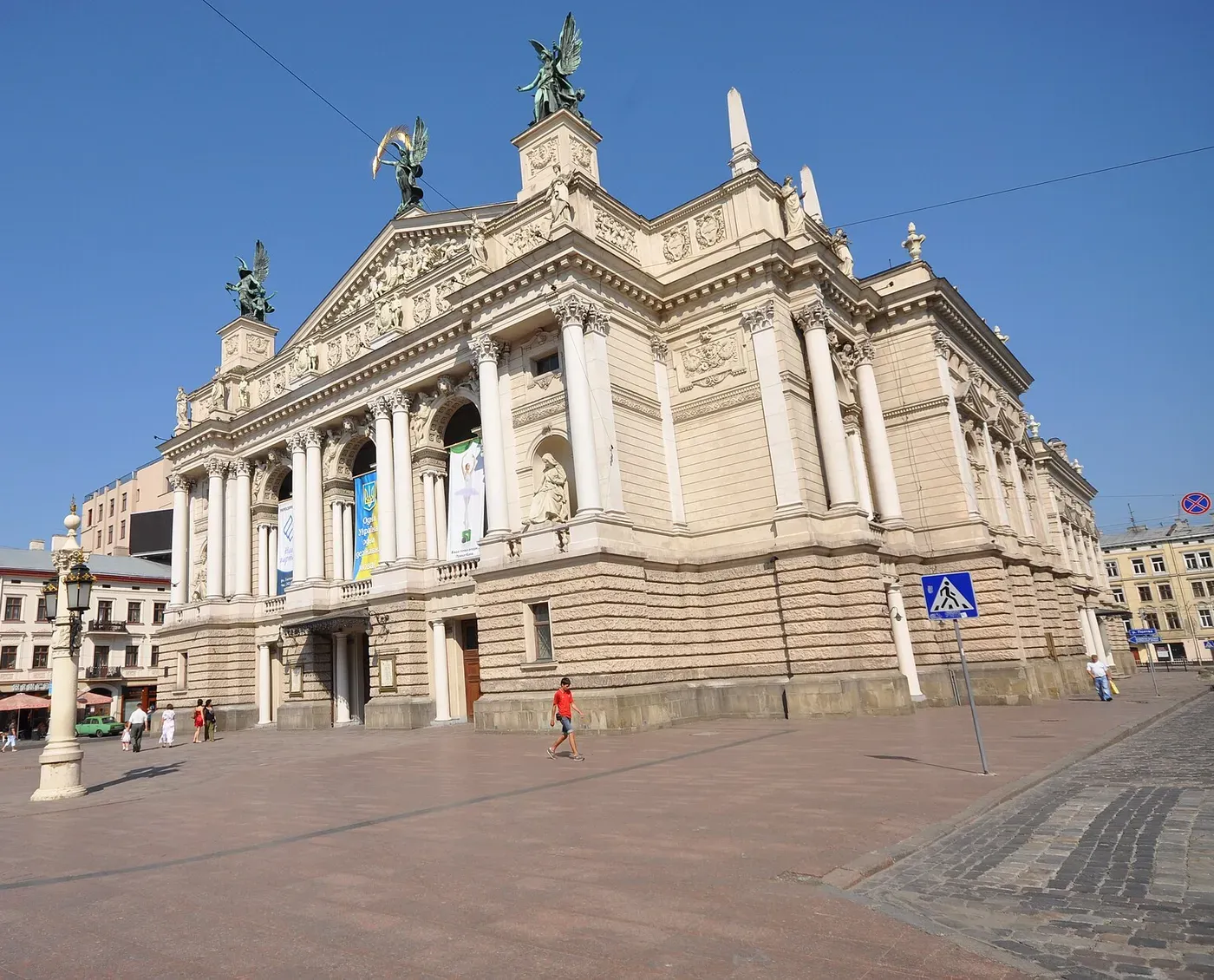

The opera house was built in 1897–1900 as the city theatre. Since 2000 the Lviv Theatre of Opera and Ballet has carried the name of the soprano Solomiia Krushelnytska.
More than the old town
The World Heritage property covers 120 hectares, only a small part of today’s city. Lviv is not a museum: the old centre is one layer of a large, living city, and its story is one where Ukrainian, Polish, Austrian, Jewish and Armenian histories meet.
If you want to read about Lviv in Ukrainian, the A2 story A weekend in Lviv follows two friends around the old town.

A little Ukrainian
Words for walking round an old town. Notice how Львів changes: у Льво́ві, in Lviv; до Льво́ва, to Lviv; зі Льво́ва, from Lviv.
- Львів
- Lvivmasculine; the і becomes о in the other forms: Льво́ва, Льво́ві
- пло́ща
- squarefeminine; пло́ща Ри́нок, Rynok Square
- ву́лиця
- streetfeminine
- ра́туша
- town hallfeminine
- собо́р
- cathedralmasculine
- це́рква
- churchfeminine; plural церкви́
Words without a native-speaker recording are read by a computer-generated voice (OpenAI text-to-speech); the written form, with its stress marks, is the reference.
Read about it in Ukrainian
A short text on this topic, with a word list, a translation, audio and questions.
Related learning
Picture credits
- Illustration of a quiet cobbled street with old houses and café tables: made for Blabober with Recraft.
- A view over a row of colourful old town houses and red and grey roofs, with a large green church dome on the left and a tall, slender bell tower in the centre, and green wooded hills on the horizon under a cloudy blue sky: Photo: Lestat (Jan Mehlich), Wikimedia Commons, CC BY-SA 3.0, file page.
- A long, pale-yellow building with rows of tall windows and arched doorways at ground level, and a tall square clock tower rising from its centre with a blue-and-yellow flag on top, under a clear blue sky: Photo: Aeou, Wikimedia Commons, CC BY-SA 4.0, file page.
- A pale-yellow baroque church with a large dome and ornate towers, glowing in low golden sunlight against a dark cloudy sky, above a yellow wall with a gate and wide stone steps: Photo: Ryzhkov Sergey, Wikimedia Commons, CC BY-SA 4.0, file page.
- A large, cream-coloured theatre building with columns, arched windows and a carved pediment, topped by three dark bronze statues of winged figures, on a wide square under a blue sky: Photo: Jorge Láscar, Wikimedia Commons (cropped), CC BY 2.0, file page.
Sources
- Lviv (A. Figol, V. Kubijovyč, A. Zhukovsky (updated 2016), Internet Encyclopedia of Ukraine, Canadian Institute of Ukrainian Studies)
- Saint George's Cathedral (Internet Encyclopedia of Ukraine)
- Lviv National Academic Theater of Opera and Ballet (Internet Encyclopedia of Ukraine)
- L'viv – the Ensemble of the Historic Centre (UNESCO World Heritage Centre)
- Ukraine: UNESCO sites in Kyiv and Lviv are inscribed on the List of World Heritage in Danger (UNESCO)
- Lvov (United States Holocaust Memorial Museum, Holocaust Encyclopedia)
- The Lwów Pogrom of July 1, 1941 (United States Holocaust Memorial Museum, Holocaust Encyclopedia)
- Poles in Ukraine (Internet Encyclopedia of Ukraine)
- Resettlement (Internet Encyclopedia of Ukraine)
- Lviv opens Jewish memorial on former historic synagogue (Cnaan Liphshiz, JTA (Jewish Telegraphic Agency), 5 September 2016)
- Golden Rose Synagogue (Lviv Interactive, Center for Urban History of East Central Europe)
- History of the university (Ivan Franko National University of Lviv)
- Lviv, UNESCO Creative City of Literature (UNESCO Creative Cities Network (the city's member profile))
- Ukrainian Soviet Socialist Republic (Internet Encyclopedia of Ukraine)
- Горох — онлайн-бібліотека словників української мови (Словозміна) (goroh.pp.ua)
Last updated